Introduction
Teaching an emergency recall command is one of the most valuable things you can do for your dog. A reliable recall can help prevent a dog from running toward a busy road, chasing wildlife, approaching an unsafe animal, or disappearing through an open gate. Unlike an ordinary “come” cue, an emergency recall is designed for situations where your dog needs to turn away from whatever has captured their attention and return to you immediately.
The important thing to understand is that dogs do not automatically know that “come” means they should stop everything and run back. Recall is a trained behavior built through repetition, rewards, trust, and gradually increasing distractions. Research and professional training guidance consistently emphasize reward-based methods, careful progression, and avoiding situations where the dog repeatedly learns that ignoring the cue is an option.
With the right approach, you can build an emergency recall command that your dog understands as exceptionally important.
What Is an Emergency Recall Command?
An emergency recall command is a special word, sound, or whistle that tells your dog to return to you immediately. It should be different from everyday instructions such as “come,” “here,” or your dog’s name.
The reason for having a separate cue is simple. Everyday recall gets used frequently. You might call your dog for dinner, to come inside, to put on a leash, or to leave the backyard. An emergency cue should be protected from this everyday use.
For example, you might choose a unique word such as “Rocket,” a specific whistle pattern, or another sound your dog does not hear during normal conversation. The cue should always predict something exceptionally rewarding.

An emergency recall command is not a magic button, however. No responsible trainer can guarantee that a dog will respond perfectly in every conceivable situation. The goal is to build an extremely strong response and maintain it throughout the dog’s life.
Why Dogs Ignore Come When Called
Before teaching an emergency recall command, it helps to understand why ordinary recall often fails.
Dogs make decisions based partly on the value of what is happening around them. Coming toward you might be rewarding, but chasing a squirrel, greeting another dog, following a scent, or exploring a new environment can be even more exciting.
Another common problem occurs when owners accidentally teach their dogs that “come” predicts something unpleasant. If calling your dog always means the walk ends, playtime stops, bath time begins, or nails are clipped, the dog can learn that returning is not particularly rewarding. Trainers often describe this as a “poisoned” recall cue.
Repeatedly shouting the cue creates another problem. If you say “come” five or six times before your dog responds, the dog can learn that the first command is optional.
The solution is to create a powerful association between the emergency recall command and an exceptionally good outcome.
Choose a Special Emergency Recall Cue
Start by choosing a cue you can use consistently.
Avoid a word you already say frequently. If you constantly tell your dog “here” during ordinary interactions, it is not ideal as an emergency cue. A whistle can work particularly well because it is consistent and can carry farther than a spoken word.
Once you choose the cue, protect it. Do not casually use it when your dog is unlikely to respond.
The emergency recall command should have a very specific meaning: turn around, move quickly toward the handler, and stay close enough to be safely secured.
Consistency matters because dogs learn through associations. The more consistently the same sound predicts an exceptional reward, the stronger its meaning becomes.
Build the Emergency Recall Association Indoors
Begin in a quiet room where your dog has very little competition for attention.
Prepare an exceptionally valuable reward. This could be small pieces of cooked chicken, another food your dog loves, or a favorite toy if your dog is strongly play motivated. The reward should be significantly more exciting than the treats your dog receives during ordinary training.
Give the emergency cue and immediately provide the reward. At this early stage, you are not testing whether your dog can run across the room. You are teaching the dog that this unusual sound predicts something wonderful.
Repeat the exercise during short sessions. Keep the experience upbeat and easy.
Eventually, your dog should hear the cue and immediately look toward you or move toward you because the sound has developed a powerful positive association.
This foundation is important. If you introduce the emergency recall command in a difficult environment too soon, your dog may fail simply because the environment is more rewarding than anything you can offer.
Teach Your Dog to Run All the Way to You
Once your dog consistently responds to the cue indoors, begin adding a little distance.
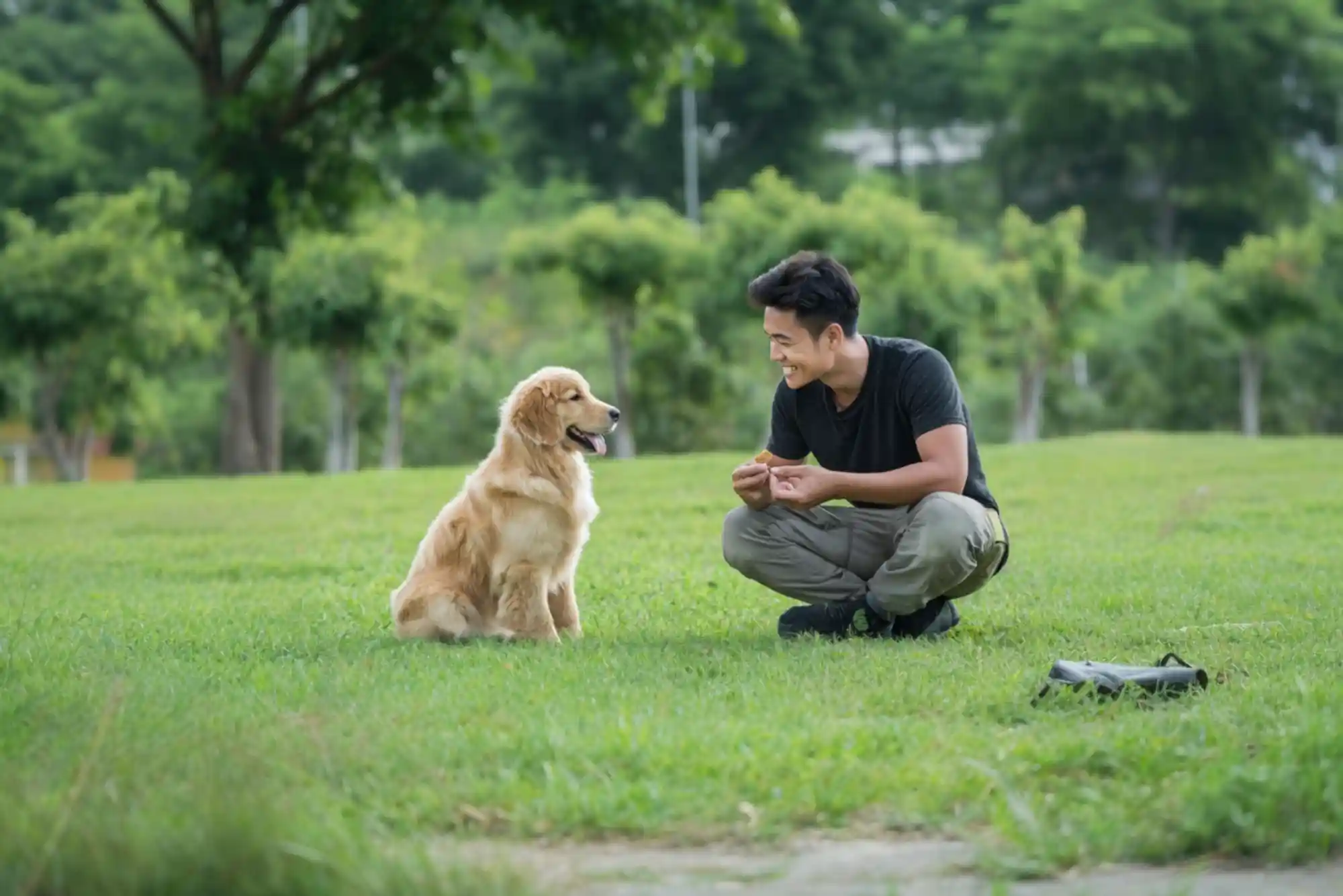
Have your dog a few feet away. Give the emergency recall command and encourage movement toward you. When the dog reaches you, deliver the jackpot reward immediately.
Make arriving at you worthwhile.
It is also useful to gently take hold of your dog’s collar or harness after they arrive, followed by another reward. This matters because an emergency recall may eventually require you to secure your dog quickly.
Do not grab roughly or turn the exercise into restraint. The dog should learn that being reached, touched, and secured after returning is still safe and rewarding.
You can then release your dog and return to normal activities. This prevents every recall from becoming a signal that freedom is over.
Move to a Long Line Before Off-Leash Training
A long line provides an important safety bridge between indoor training and real-world recall.
Take your dog to a secure, quiet outdoor environment and attach an appropriate long line to a properly fitted harness or collar. Give your dog enough freedom to explore while maintaining control of the situation.
Call only when you have a reasonable chance of success.
When your dog responds, reward generously. If the dog does not respond, avoid repeatedly shouting the emergency cue. Instead, manage the situation safely with the long line and return to an easier training level.
The long line should not be used to punish or forcibly drag your dog toward you. Its purpose is to prevent the dog from practicing running away while you build the desired behavior.
Gradually Add Distractions
A dog that responds perfectly in your living room does not necessarily have a reliable recall at a busy park.
This is because dogs learn behaviors within contexts. Outdoor environments introduce smells, movement, people, animals, noises, and other competing rewards.
Increase difficulty gradually.
Start with a quiet yard or calm outdoor area. Once your dog responds consistently, introduce mild distractions. Later, practice around greater distance and more interesting environments while maintaining the long line.
If your dog stops responding, the environment has probably become too difficult. Move back to an easier situation instead of repeatedly testing the dog.
A useful rule is to increase only one major challenge at a time. If you suddenly add a large distance, unfamiliar location, other dogs, wildlife, and exciting movement simultaneously, you are making the exercise unnecessarily difficult.
Make the Reward Worth Coming Back For
The reward is one of the most important parts of an emergency recall command.
Imagine your dog is watching a squirrel. You are asking the dog to abandon something extremely interesting and choose you instead. A tiny piece of ordinary kibble may not be enough motivation.
Use rewards strategically.
During emergency recall training, reserve the highest-value rewards for successful responses. You can use food, enthusiastic praise, tug, a favorite toy, or a combination depending on what motivates your dog.
The reward should arrive immediately after the dog reaches you. Timing helps the dog understand exactly which behavior earned the jackpot.
As training becomes reliable, you can vary the rewards, but do not assume that a critical safety behavior should eventually become completely reward-free. Maintaining a strong reinforcement history helps keep recall valuable over time.
Never Punish Your Dog for Coming Back
This rule is extremely important.
Suppose your dog escapes through an open gate and spends five minutes running around before finally returning. You may feel frustrated. However, once the dog comes back, punishment can make future recalls worse.
From the dog’s perspective, returning to you just resulted in something unpleasant.
Instead, reward the return and deal with the underlying problem later.
This does not mean that running away should be ignored. It means the recall itself must remain safe and rewarding.
If you punish the dog after a difficult recall, you risk teaching exactly the opposite behavior you want. The dog may become more hesitant to approach you the next time you call.
Do Not Use the Emergency Cue for Everyday Tasks
Protect your emergency recall command carefully.
Do not use it every time your dog needs to come inside. Do not use it before a bath, nail trim, crate session, or other activity your dog dislikes.
If you need your dog for an ordinary task, use the regular recall cue or physically manage the situation in another safe way.
The emergency cue should remain rare and special.
Some trainers recommend practicing it frequently during the initial conditioning period and then using it sparingly once the response is established. This protects the cue from becoming ordinary background noise.
Practice the Emergency Recall in Real-Life Situations
Training should eventually move beyond controlled exercises.
Practice in different safe environments, such as your home, a secure yard, a quiet field, and other appropriate locations. Continue using a long line until you are genuinely confident in your dog’s response.
Remember that changing locations can effectively increase the difficulty even if the physical distance remains the same.
A dog that responds beautifully in one familiar yard may hesitate in an unfamiliar field.
That is normal.
Your job is to build a history of successful recalls in different contexts rather than expecting one training session to create universal reliability.
Common Emergency Recall Mistakes
One of the biggest mistakes is testing the emergency recall before it is ready. Owners sometimes take a dog to a park, see a squirrel, and immediately try the new cue. If the dog ignores it, the cue has just been weakened.
Another mistake is using the emergency recall too frequently. A special cue loses some of its value when it becomes an ordinary command.
Calling repeatedly is also problematic. Give the cue clearly rather than turning it into a long stream of “come, come, come.”
Finally, do not make every successful recall end the fun. Sometimes call your dog, reward them, briefly hold the collar, and then release them to continue playing. This teaches your dog that coming back does not automatically mean something enjoyable is finished.
How Long Does Emergency Recall Training Take?
There is no universal timeline.
A confident adult dog with a strong training history may progress quickly, while a fearful rescue dog, highly independent breed, adolescent dog, or dog with a history of ignoring recall may need considerably more time.
The important measure is reliability at each level, not the number of days you have been training.
Do not move from the living room to an off-leash park simply because you have practiced for two weeks. Move forward when your dog is consistently successful at the current difficulty.
Short, successful sessions are usually more productive than exhausting training sessions.
When to Get Professional Help
If your dog has a serious tendency to bolt, has repeatedly escaped, shows intense fear outdoors, chases vehicles, or becomes highly aroused around animals, professional assistance can be valuable.
A qualified reward-based trainer can observe your timing, handling, reinforcement, and training environment and identify problems that may be difficult to notice yourself.
For severe behavioral concerns, veterinary behavioral guidance may also be appropriate.
The objective is not simply to teach your dog a word. It is to create a safe, predictable behavior that holds up when the environment becomes challenging.
Build a Recall You Can Trust
An effective emergency recall command is built long before an actual emergency happens. Start in a quiet environment, choose a unique cue, pair it with extraordinary rewards, and gradually introduce distance and distractions.
Never punish your dog for returning. Never repeatedly use the emergency cue when success is unlikely. Most importantly, do not rush the process.
A reliable recall is developed through hundreds of successful decisions in which your dog learns that turning away from the environment and running toward you is an excellent choice. Reward-based training, controlled progression, and lifelong maintenance can make that choice increasingly automatic.
Start practicing today with just a few easy repetitions indoors. Build the habit carefully, protect the cue, and give your dog a reason to believe that coming back to you is always worth it.
FAQs
How do I teach my dog to come when called every time?
Start indoors with very short distances and a high-value reward. Say the recall cue once, encourage your dog toward you, and reward immediately when they arrive. Gradually increase distance and distractions while using a long line for safety. A dog should not be expected to recall reliably around major distractions until that behavior has been trained progressively.
What is the best emergency recall command for a dog?
There is no single universally best word. The most effective emergency recall command is usually a unique cue that your dog does not hear during everyday interactions. A special word or consistent whistle can work well because it can be kept separate from normal recall.
Why does my dog come inside but not outside?
Outdoor environments contain far more distractions than most homes. Your dog may understand the recall but lack sufficient training around smells, wildlife, people, other dogs, and movement. Return to a quieter outdoor location and gradually increase distractions rather than immediately testing recall in a busy environment.
How do I get my dog to come when called without treats?
Food is not the only possible reward. Toys, play, praise, access to something enjoyable, and other reinforcers can maintain recall. However, there is no need to eliminate rewards simply because your dog becomes reliable. A strong reinforcement history is useful for maintaining an important safety behavior.
Should you say a dog’s name before come?
You can use your dog’s name to gain attention, but the actual recall cue should remain clear and consistent. For an emergency recall, using one distinctive sound or word can help keep the behavior separate from everyday communication.
What should I do if my dog ignores the recall command?
Do not repeatedly shout the cue or punish the dog after they return. Safely manage the situation with a leash or long line, then make the next training session easier. Repeated failures usually mean the training environment is currently too difficult.
Can an older dog learn an emergency recall?
Yes. Older dogs can learn new recall behaviors, although training speed varies between individuals. Start with the same foundation: a clear cue, exceptional rewards, easy environments, short sessions, and gradual increases in distance and distraction.
How often should I practice emergency recall?
Practice regularly but keep sessions short and successful. During initial conditioning, several easy repetitions can build the association. Once the behavior is strong, occasional carefully planned practice can help maintain it. Avoid repeatedly testing the emergency cue just to see whether it still works.
Is emergency recall the same as normal recall?
Not exactly. Normal recall is used in everyday situations, while an emergency recall command is a specially protected cue reserved for situations where an immediate return is particularly important. Keeping the two cues separate can help preserve the emergency cue’s value.