Introduction
Choosing the right harness for a large or working dog is about much more than appearance. Strong dogs need dependable control, comfortable pressure distribution, secure attachment points, and hardware that can handle everyday use. This is why tactical dog harnesses with handle have become popular among owners of large breeds, working dogs, service dogs, and active companions.
A well-designed tactical harness can provide a convenient grab point for close control while giving the handler multiple options for leash attachment. Many models also include padded sections, adjustable straps, reinforced stitching, MOLLE-style webbing, and identification panels. However, not every product marketed as “tactical” offers the same construction or fit.
For large breeds, the most important consideration is still proper sizing. Chest girth should be measured carefully and compared with the manufacturer’s actual size chart rather than relying only on labels such as Large or XL.
This guide explains what makes a tactical harness useful, how to choose one for a powerful dog, and what service-dog handlers should know before buying.
What Makes Tactical Dog Harnesses With Handle Different?
Traditional walking harnesses are primarily designed to provide comfortable leash control. Tactical models generally add features intended for working environments, training, outdoor activities, and situations where the handler may need more direct physical control.
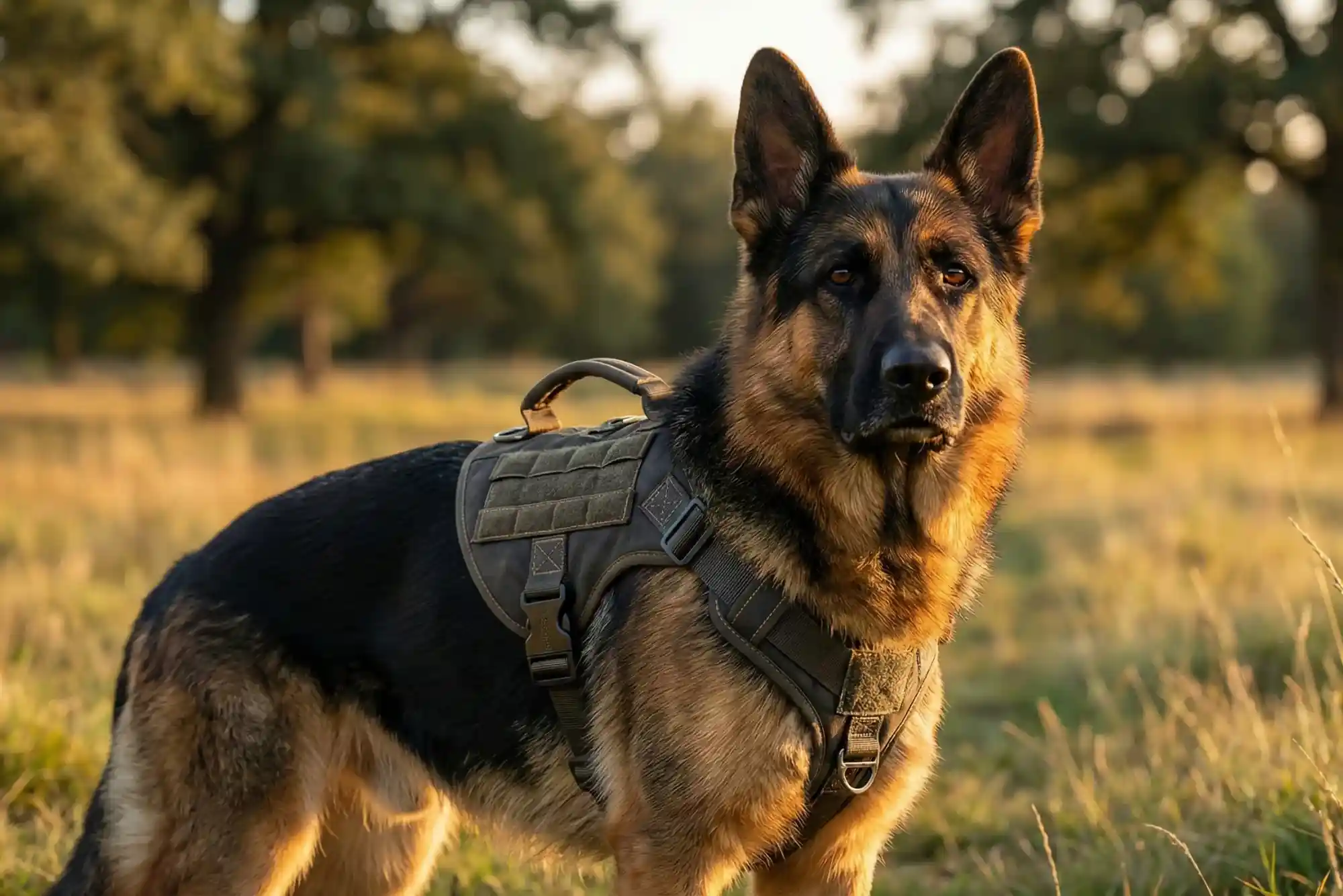
The most noticeable feature is the handle positioned along the dog’s back. A reinforced handle allows the handler to quickly hold the dog closer without reaching for the collar. This can be useful when moving through crowded areas, navigating difficult terrain, getting the dog into a vehicle, or managing a moment of increased excitement.

Many tactical designs also use multiple leash attachment points. A rear D-ring can work well for ordinary walking, while a front attachment can provide another option during training. Some designs add MOLLE-compatible webbing for carrying small accessories or identification equipment. Current tactical harnesses range from relatively lightweight everyday designs to heavier working-dog equipment with substantial hardware.
The key point is that “tactical” describes a style and feature set, not a universal performance standard. Buyers should examine the actual materials, stitching, buckles, adjustment system, and manufacturer specifications.
Why Large Breeds Benefit From a Harness With a Handle
Large dogs generate considerably more force when they pull, change direction, or become distracted. A properly fitted harness distributes contact across the chest and body rather than concentrating all leash pressure around the neck.
The handle provides another layer of control. If a 90-pound German Shepherd suddenly needs to be redirected, reaching for a back-mounted handle can be quicker and more practical than trying to grab a collar.
This does not mean a handle should be used to lift a heavy dog routinely. Unless the manufacturer specifically states that a handle is designed and rated for lifting, it should be treated primarily as a control point. Some specialized harnesses are specifically constructed for lifting or assisting dogs over obstacles, but ordinary tactical handles should not automatically be assumed to have that capability.
For large breeds, construction matters just as much as the presence of a handle. Reinforced stitching, strong webbing, secure buckles, and properly attached D-rings are worth examining before purchase.
Key Features to Look for in Tactical Dog Harnesses With Handle
Reinforced Control Handle
The handle is one of the main reasons people choose tactical harnesses. Look for a handle that is firmly integrated into the harness rather than simply stitched onto a thin outer layer.
A handle should feel secure when you use it for brief close-control situations. If the manufacturer provides specific load or hardware ratings, those specifications are more useful than vague terms such as “heavy duty.”
For example, some current tactical models publish ratings for their buckles and D-rings, while other products make durability claims without providing comparable testing information.
Durable Webbing and Stitching
Large dogs can place significant force on harness seams. Look for reinforced stress points and quality webbing around the chest, back, and handle.
High-denier nylon is common in tactical designs. Some products use 1000D or 1050D nylon, while others use lighter materials to reduce weight. A heavier fabric is not automatically better for every dog because additional material can increase heat and bulk.
The right choice depends on how the harness will actually be used.
Secure Buckles
Buckles are another important consideration. A tactical harness may use plastic quick-release buckles, metal hardware, or a combination.
Metal hardware can provide a substantial feel, but material alone does not tell you how strong the complete harness is. The attachment method, stitching, buckle design, and overall construction matter too.
For a powerful dog, examine whether the manufacturer clearly identifies the hardware and provides useful specifications rather than relying only on phrases such as “military grade.”
Multiple Adjustment Points
Large breeds come in very different shapes. A deep-chested German Shepherd does not have exactly the same body proportions as a Labrador Retriever or Rottweiler.
Multiple adjustment points make it easier to create a secure fit around the chest and neck. A harness that can be adjusted independently in several areas is generally easier to customize than a design with minimal adjustment.
Proper fitting also helps prevent rubbing around the armpits and reduces the chance of the dog backing out of the harness.
How to Choose the Right Size for a Large Dog
Sizing is arguably more important than brand name. A beautifully constructed harness will not perform properly if it is too loose, too tight, or positioned incorrectly.
Start by measuring the dog’s chest girth around the deepest part of the rib cage, generally just behind the front legs. Measure while the dog is standing naturally. Compare the measurement with the manufacturer’s size chart.
Do not assume that every “Large” harness has the same dimensions. One company’s Large may fit a completely different chest circumference than another company’s Large.
The American Kennel Club recommends allowing enough room for comfortable movement and using the two-finger rule when checking fit.
After putting the harness on, inspect the areas around the front legs. The straps should not dig into the armpits. The harness should remain stable during movement without sliding excessively from side to side.
A dog should also be able to walk, sit, lie down, and turn its head naturally.
Tactical Harnesses for German Shepherds, Rottweilers, and Other Strong Breeds
German Shepherds, Belgian Malinois, Rottweilers, Dobermans, Huskies, and similarly powerful breeds are common candidates for robust working-style harnesses.
A German Shepherd may benefit from a harness with substantial adjustment range because of its deep chest and athletic build. Rottweilers may require a wider chest section and careful attention to girth sizing. Dogs with particularly large frames may need specialized models that extend beyond conventional XL sizing.
Some current manufacturers advertise tactical harnesses for dogs weighing well over 100 pounds, but weight alone should never determine the correct size. Chest circumference and the manufacturer’s measurements remain more useful for selecting the actual harness.
For especially large dogs, check the maximum girth measurement before purchasing. A harness that technically supports a high weight range may still be unsuitable if its chest dimensions do not match your dog.
Are Tactical Dog Harnesses Suitable for Service Dogs?
A tactical harness can be used by a service-dog handler if it provides the fit and functionality the team needs. However, the harness itself does not make a dog a service animal.
Under the Americans with Disabilities Act, a service animal is a dog individually trained to perform work or tasks directly related to a person’s disability. The ADA does not require a service dog to wear a particular vest, patch, or harness.
This distinction is important because many commercial harnesses use terms such as “service dog” in their product descriptions. A label or patch is not a substitute for service-dog training.
For a genuine service dog, the harness should support the dog’s actual working requirements. Depending on the dog’s tasks, the handler may prioritize stability, easy access to the handle, low-profile construction, identification panels, or specific leash attachment points.
The dog should also remain comfortable during extended periods of work. A bulky harness that restricts movement or creates excessive heat may be unsuitable for long working sessions even if its construction is durable.
Can the Handle Be Used for Mobility Assistance?
This requires particular care.
A standard control handle is not automatically a mobility-assistance handle. If a dog is trained to provide physical support, the equipment should be specifically designed for that purpose and selected with guidance from an appropriate professional.
Pulling against a handle can place force through the dog’s body. A harness intended only for leash control may not distribute that force appropriately for repeated weight-bearing tasks.
If mobility assistance is part of the dog’s trained work, look for equipment specifically designed and tested for that application rather than assuming a tactical grab handle is sufficient.
MOLLE Webbing: Useful Feature or Extra Bulk?
MOLLE-style webbing is common on tactical dog harnesses. It allows compatible pouches and accessories to be attached to the harness.
For working dogs, this can be useful for carrying identification materials, small supplies, lights, or other lightweight equipment. For an ordinary walking dog, however, MOLLE panels may simply add bulk.
Consider what your dog actually needs. A heavily equipped harness can become unnecessarily warm or cumbersome, particularly during summer walks.
A lighter tactical harness may be more practical for everyday use, while a heavier model can make sense for outdoor training or specialized working environments.
Comfort Matters as Much as Durability
A harness can be extremely strong and still be a poor choice if the dog dislikes wearing it.
Look for padding around pressure-sensitive areas and breathable materials where possible. Mesh sections can help reduce heat buildup, especially when a harness is worn for longer periods.
Watch your dog’s movement after fitting the harness. Look for rubbing, redness, restricted shoulder movement, unusual scratching, or reluctance to walk.
Comfort should not be treated as an optional feature. A dog that is physically uncomfortable may move differently, resist equipment, or become distracted during training.
How to Maintain a Tactical Dog Harness
Heavy-duty equipment still needs regular inspection.
Check the stitching around the handle and leash attachment points. Examine buckles for cracks or deformation. Inspect webbing for fraying, cuts, or stretched areas. If the harness has MOLLE attachments, make sure accessories are not pulling unevenly on the material.
Cleaning instructions vary by manufacturer. Some tactical harnesses should be hand-washed rather than placed in a washing machine. Follow the care instructions supplied with the specific model.
A harness that has suffered significant structural damage should not be kept in service simply because the outer fabric still looks acceptable.
Common Mistakes When Buying a Tactical Dog Harness
One common mistake is choosing a size based only on the dog’s weight. Weight can help narrow down options, but it does not replace chest measurements.
Another mistake is assuming every handle is designed for lifting. Unless the manufacturer specifically states otherwise, use the handle primarily for control.
Some buyers also focus heavily on MOLLE panels and patches while overlooking the fundamentals. A tactical harness needs to fit correctly, stay secure during movement, and provide appropriate leash attachment points.
Finally, avoid assuming that “military style,” “service,” or “heavy duty” automatically means professional-grade construction. Look at the actual specifications and construction details instead. Current product comparisons show substantial variation between tactical harnesses in fabric, buckle materials, attachment points, and published load ratings.
Choosing Tactical Dog Harnesses With Handle
The best tactical dog harnesses with handle are not necessarily the heaviest or most heavily accessorized. The right harness is the one that fits your dog securely, provides dependable control, uses appropriate materials and hardware, and remains comfortable during the activities you actually perform.
For large breeds, pay particular attention to chest girth, adjustment range, handle construction, leash attachment points, and stitching. For service dogs, focus on the dog’s actual working requirements rather than relying on labels or patches.
Before buying, measure your dog’s chest carefully and compare those measurements with the manufacturer’s sizing chart. Inspect the harness regularly after purchase, especially around the handle and attachment points.
FAQs
What is the best tactical dog harness?
The right tactical dog harness depends on the dog’s size, body shape, activity, and the level of control required. Look for an accurate girth range, secure attachment points, a reinforced handle, suitable hardware, and comfortable adjustment. A harness should be selected for the dog’s specific job rather than based solely on marketing claims.
What dog harness does the military use?
Military and working-dog equipment varies according to the organization, task, dog, and operational requirements. Consumer tactical harnesses borrow features associated with working-dog equipment, including MOLLE webbing, reinforced handles, durable nylon, and multiple attachment points. A commercial tactical harness should not automatically be considered equivalent to specialized military K9 equipment.
Are tactical dog harnesses good for large dogs?
They can be useful for large dogs because many designs provide strong control handles, multiple adjustment points, and robust attachment hardware. However, the harness must be correctly sized and suitable for the dog’s activity. A heavy harness can also become uncomfortable if it is unnecessarily bulky or poorly ventilated.
Are tactical harnesses good for service dogs?
A tactical harness can be appropriate for a service dog if it fits correctly and supports the dog’s working needs. Under the ADA, however, a service dog does not need a special harness or vest to qualify as a service animal. The important factor is the dog’s trained work or tasks related to the person’s disability.
Can you lift a dog with a tactical harness handle?
Not necessarily. A standard grab handle should not automatically be treated as a lifting handle. Only use a harness for lifting when the manufacturer specifically designs and states that it is appropriate for that purpose. For repeated lifting or mobility assistance, specialized equipment is more appropriate.
How tight should a tactical dog harness be?
The harness should be secure without restricting movement or causing pressure. The AKC recommends allowing enough room for comfort and checking the fit with the two-finger rule. Always follow the specific manufacturer’s fitting instructions as designs differ.